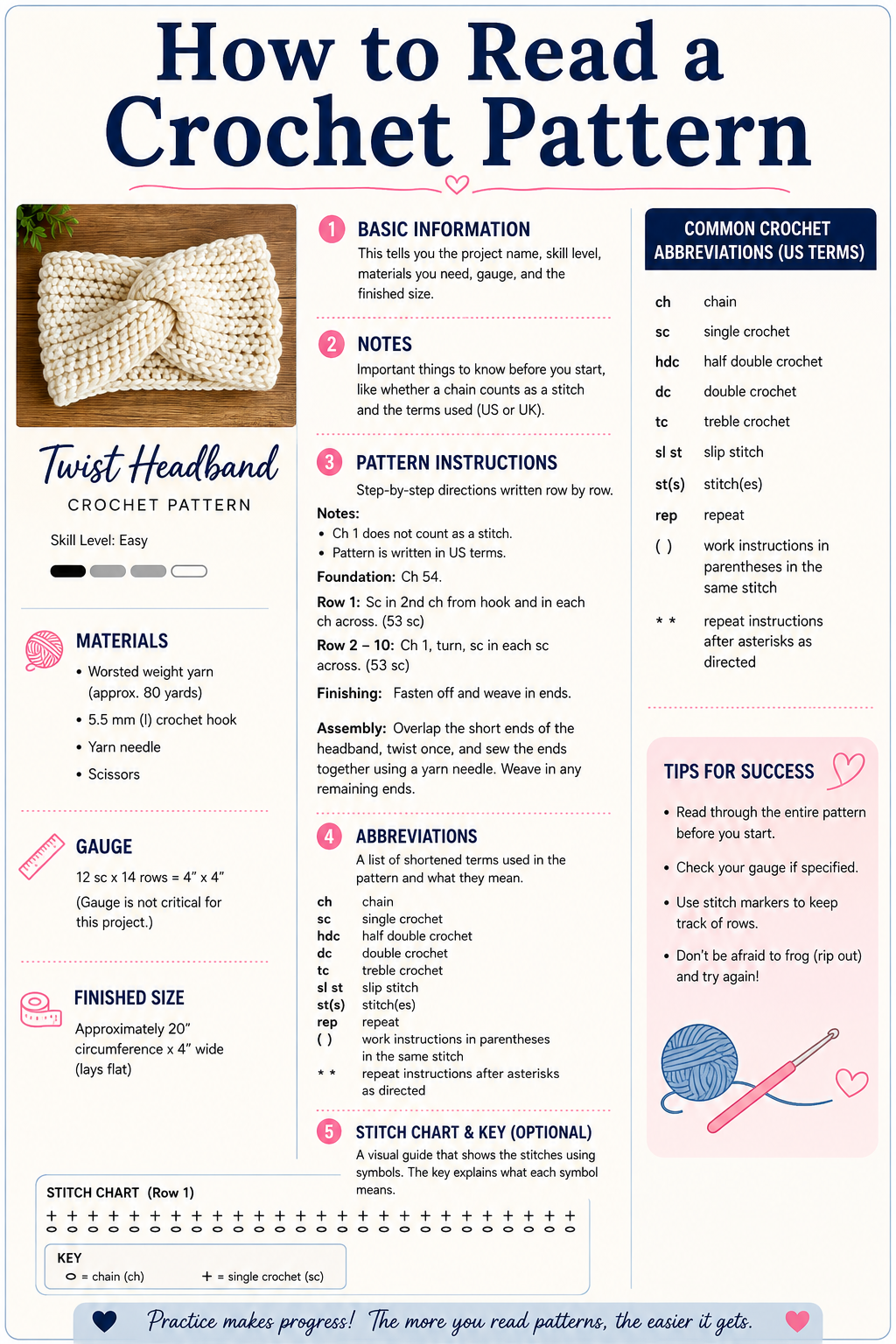
How to Read a Crochet Pattern
A simple guide for beginners
What Is a Crochet Pattern?
A crochet pattern is a set of written instructions that tells you:
What stitches to use
How many stitches to make
The order to follow
Think of it like a recipe—but for yarn
1. Start with the Pattern Information
Before you begin, read the top section carefully. It usually includes:
Skill level (Beginner, Easy, Intermediate)
Materials (yarn, hook size, tools)
Finished size
Gauge (how tight or loose your stitches are)
Notes (things you should know before starting)
Special stitches (special stitches other than basic stitches used)
Skipping this step is the #1 beginner mistake!
2. Learn Common Abbreviations (US Terms)
Patterns use short abbreviations to keep things simple:
ch = chain
sc = single crochet
hdc = half double crochet
dc = double crochet
sl st = slip stitch
inc = increase (2 stitches in one)
dec = decrease
Most patterns include a key—always check it!
3. Understanding Pattern Repeats
Many patterns have repeats and they are abbreviated like this:
You’ll often see something like:
sc, inc x6
This just means you repeat that sequence 6 times.
Repeats make patterns easier to write and follow, and once you get used to them, they feel very natural.
4. Working in Rows vs Rounds
Rows (back and forth)
Turn your work at the end of each row
Common for scarves, blankets
Rounds (in a circle)
Do NOT turn
Use a stitch marker
Common for hats, amigurumi
5. Stitch Counts Matter
At the end of each row/round, you’ll see a number:
Example:
sc, inc x6 (18)
The (18) = total stitches you should have
Always count your stitches—this prevents mistakes later!
6. Special Pattern Terms
Magic Ring (MR): Adjustable starting loop
Yarn Over (YO): Wrap the yarn around the hook
Back Loop Only (BLO): Work in back part of stitch
Front Loop Only (FLO): Work in front part
Fasten off: Cut yarn and secure
7. Reading Step-by-Step
Example pattern line:
Round 3: sc, inc x6 (18)
This means:
Work 1 single crochet
Then 2 single crochet in next stitch
Repeat that 6 times
You should end with 18 stitches
Beginner Tips
Go slow—don’t rush
Read the whole pattern before starting
Use a stitch marker
Highlight or check off rows as you go
It’s okay to undo and try again
Every stitch is progress!
Parentheses, Asterisks, and Brackets
As you start reading crochet patterns, you’ll notice that patterns don’t just use abbreviations — they also use symbols to help guide you through repeated steps.
At first, these symbols can look a little confusing, but once you understand what they mean, patterns become much easier to follow.
Parentheses: Parentheses are used when you work more than one stitch into a space. For example:
Row 1: Ch 1, (dc, ch2, dc) Which is in the first Row, Chain 1, work a double crochet, a chain 2, then another double crochet in the same stitch.
Asterisks: Crochet patterns often repeat the same group of steps several times across a row. Instead of writing those same directions out over and over, the pattern uses asterisks (*) to show you where the repeated section begins.
For example:
Row 3: Dc in the next 2 sts, ch 1, skip next st, dc in the next st. Rep from across the row.
Here you would repeat the steps after the * as many times as you can until you reach the end of the row.
Brackets: Brackets are used to indicate how many times you work a repeat across the row or round.
For example:
Row 7: Dc in next 3dc, ch 1, [sk next dc, 3dc in next dc] 4 times, ch 1, dc in next 4 dc.
This means that after you double crochet in the next 3 stitches, you will repeat the steps following the asterisk — chain 1, skip the next stitch, and 3 double crochet in the next stitch — all the way across the row.